Poilvache Castle

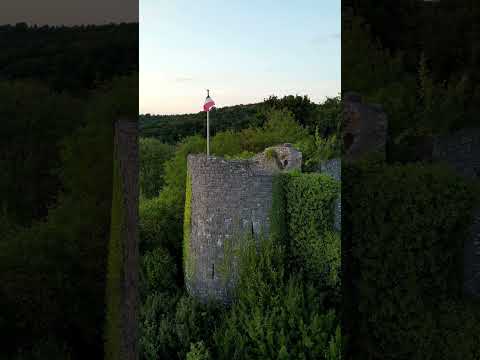
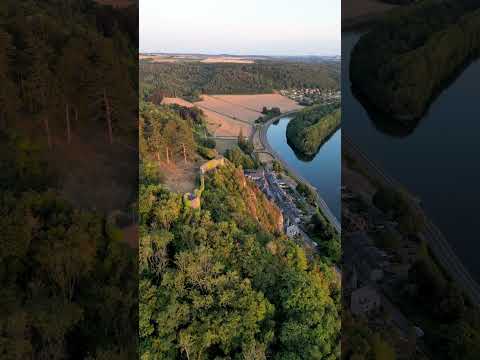
Poilvache Castle is a ruined medieval fortress located in the Walloon municipality of Yvoir, within the province of Namur, Belgium. Perched dramatically on a clifftop overlooking the village of Houx and the River Meuse, the site commands a strategic view of the surrounding landscape. While the visible ruins primarily date back to the 15th century, historical records indicate that a fortification has existed on this prominent location since the era of Charlemagne. The structure stands as a testament to centuries of military history in the region, having evolved from an early defensive post into a substantial stronghold.
The castle holds significant historical importance due to its association with the once-thriving walled town of Poilvache. During the Middle Ages, this settlement was an economic hub with its own mint and was allied with Duke Philip the Good. However, the town and castle suffered a devastating siege in 1430 led by Jean de Heynsbergh, the rebellious Prince-Bishop of Liège, who commanded an estimated army of 30,000 troops. This catastrophic event effectively ended the existence of the prosperous town. Today, the entire site is recognized as one of Wallonia's Major Heritage sites, preserving the memory of its turbulent past despite its ruined condition.
Beyond its medieval origins, the location played a role in modern warfare during World War II. From the rocky heights of the castle grounds, observers can see the specific island in the River Meuse where German armored divisions crossed on May 13, 1940, marking a critical moment in the Battle of France. Although it is impossible to view the complete extent of the archaeological site from any single vantage point, the ruins remain a protected landmark. The castle is categorized among the ruined castles of Belgium and continues to serve as a historical monument rather than a functional residence or active military installation.
Videos
Details
- Notes
- château fort
- Location Text
- Houx, Yvoir