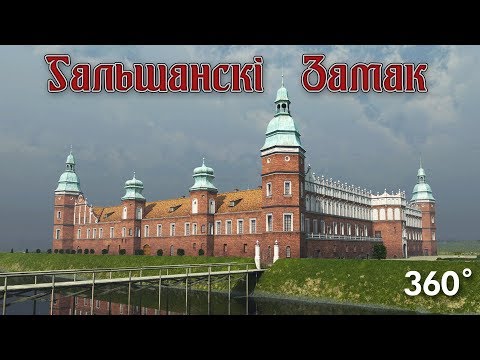
Halshany Castle

Halshany Castle, also known as Holszany Castle, is a historic ruined residence located in Halshany within the Hrodna Voblast of Belarus. Originally the seat of one of the largest land estates in the Grand Duchy of Lithuania, the current structure was constructed around 1610 by Paweł Stefan Sapieha. It replaced an older fortress belonging to the princely Holszanski family, from whom the powerful Sapieha magnates descended. Built primarily of red brick, the residence was once considered one of the most elegant private châteaux in the region, famously rivaling the renowned Mir Castle. Despite its brick construction, it acquired the nickname "Black Castle," a title later popularized by a fictionalized account in a novel by Uladzimir Karatkievich that was loosely based on the site.
The castle suffered a dramatic decline after being devastated and looted twice by invading Swedish troops during the mid-17th century Deluge and again in 1704 during the Great Northern War. Burdened by financial stress from domestic conflicts and ongoing wars, the Sapieha family never fully restored the property. Throughout the 18th century, ownership passed to the Żaba and Korsak families as creditors diminished the estate. The last Polish landlords sold the property to a Russian landlord in the late 19th century, leading to the demolition of its towers in 1880. Although partially occupied with visible wall paintings during the 1880s, the structure eventually fell into complete ruin.
In recent years, efforts have been made to preserve this significant historical landmark. Government-funded restoration work on the northern tower commenced in 2018, signaling a renewed interest in maintaining the site's heritage. Today, the ruins serve as a cultural hub where an annual tournament is held near its walls each summer, drawing visitors to celebrate the legacy of this former grand estate.