Hailongtun Castle

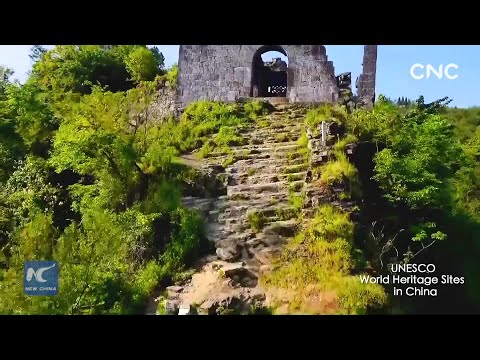
Hailongtun Castle is a historic fortress situated on Longyan Mountain in Gaoping Town, Zunyi City, within China's Guizhou Province. Originally constructed in 1257 during the Southern Song dynasty, it served as the strategic stronghold for the Chiefdom of Bozhou, which was ruled by the Yang family for centuries. The site represents a unique example of feudal castle architecture in China, distinguished by its massive scale and defensive design. The complex covers an area of approximately 1.59 square kilometers and features nearly six kilometers of stone walls that follow the natural contours of the mountainous terrain. Its layout includes six eastern passes and three western passes, utilizing the surrounding cliffs to create a formidable barrier against invasion.
The historical significance of Hailongtun is defined by its role in the Bozhou rebellion and its eventual destruction. For over three hundred years, the fortress remained impregnable until the Ming dynasty launched a decisive campaign against the local tusi rulers. In 1600, during the 28th year of the Wanli reign, Ming forces defeated the rebellion, leading to the suicide of the last ruler, Yang Yinglong, and the subsequent burning of the castle. Today, the site exists as a well-preserved ruin that offers critical insights into the Tusi system of governance used by imperial China to manage ethnic minority regions.
In recognition of its outstanding universal value, Hailongtun was designated as a UNESCO World Heritage Site in July 2015. It stands as one of the three collective Tusi Sites inscribed on the list, marking it as the only known well-preserved feudal castle in the country. Although the structures were damaged by fire and conflict centuries ago, the remaining walls and passes provide a tangible link to the region's turbulent past. The site currently functions as an important archaeological landmark and cultural heritage destination, preserving the memory of the Yang family's long rule and the dramatic end of their autonomy.
Videos

Details
- Location Text
- (海龙屯)