Garni Temple

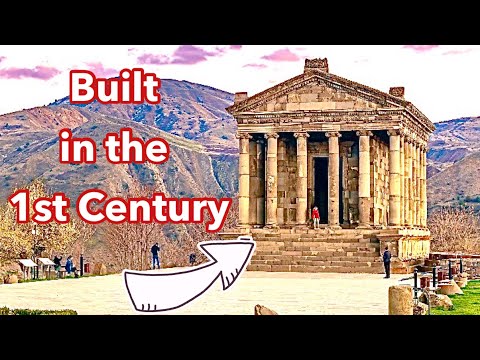
The Garni Temple is a classical colonnaded structure located in the village of Garni within Armenia's Kotayk Province, approximately thirty kilometers east of the capital, Yerevan. Situated at an elevation of 1,400 meters, this edifice stands as the best-known symbol of pre-Christian Armenia and serves as the only largely preserved Hellenistic building in the former Soviet Union. Constructed from basalt in the Ionic order, the temple reflects Ancient Greek and Roman architectural styles, marking the site as a significant eastern outpost of the Greco-Roman world. While conventionally identified as a pagan temple dedicated to the sun god Mihr and built by King Tiridates I during the first century AD, some historical hypotheses suggest it may have originally served as a royal tomb constructed in the second century.
The building suffered a catastrophic collapse during a devastating earthquake in 1679, leaving it in ruins for centuries until renewed scholarly interest sparked excavations in the early twentieth century. Between 1969 and 1975, the structure was meticulously reconstructed using the anastylosis technique under the direction of architect Alexander Sahinian, utilizing original fragments that had remained on-site. Today, the temple operates as a museum managed by the Armenian Ministry of Culture and remains a premier tourist attraction. Beyond its historical value, the site holds contemporary spiritual significance as the central shrine for followers of Hetanism, the modern neopagan movement in Armenia, where occasional religious ceremonies are still conducted.
Videos


Details
- Name
- Garni Temple
- Height M
- 10.7
- Architect
- Alexander Sahinian (reconstruction, 1969–75)
- Condition
- Museum (part of a larger protected area),occasional neopagan (Hetanist) shrine
- Materials
- Basalt
- Year Built
- 1st-17th century
- Location Text
- Garni, Kotayk Province, Armenia
- Architectural Style
- Ancient Greek/Roman