Antoing Castle

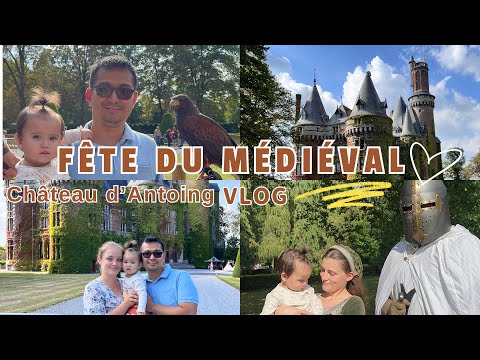
Antoing Castle, locally known as Château des Princes de Ligne, is situated along the Scheldt River in the municipality of Antoing within Hainaut province, Wallonia, Belgium. Recognized as one of the country's most famous castles, its origins trace back to the 10th century when the Count of Flanders constructed a motte-and-bailey fortress on the site. This early wooden structure was upgraded with stone fortifications and a keep in the early 12th century. The castle underwent a major transformation between 1436 and 1452 under Jean de Melum, who rebuilt it into a luxurious tower house with updated defenses. Its architectural core remains medieval, featuring distinctive round towers added during the 1400s and a corps de logis constructed near the gatehouse in the mid-16th century, which currently serves as a coach house.
The site holds significant historical weight due to its long lineage of prestigious visitors and owners. During the 15th and 16th centuries, it hosted European royalty including Henry VIII, Charles the Bold, and Philip II of Spain, while later centuries saw visits from French monarchs Louis XIV and Louis XV. In 1634, the property was inherited by the Princes de Ligne, who have owned it continuously since. The castle served diverse roles over time, functioning as a college for Jesuit students in exile from 1901 to 1914 and later as a military hospital for the Imperial German Army during World War I. Although the text notes a Neo-Gothic redesign began in the 19th century, the description cuts off before detailing the full extent of these modifications.
Today, Antoing Castle remains the private residence of the De Ligne family, maintaining its status as a prominent landmark in Belgian heritage. While it is not described as being open to the general public in the provided text, its preservation highlights the enduring legacy of the princely family. The combination of medieval defensive elements, such as the ancient keep and round towers, with later residential additions creates a unique architectural profile that reflects centuries of evolution. Its location on the Scheldt River continues to define its picturesque setting, preserving its reputation as a quintessential example of Walloon castle architecture.
Videos
Details
- Location Text
- Antoing