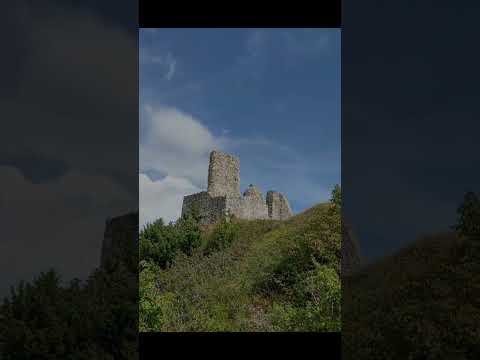
Burgruine Hohenburg auf Rosenberg

Burgruine Hohenburg auf Rosenberg is a medieval hillside castle ruin located near Spittal an der Drau in Carinthia, Austria. Situated high above the Drava Valley on the southern slope of the Ankogel Group within the Hohe Tauern mountain range, the structure overlooks the Lurnfeld region. Originally erected in the late 11th or early 12th century by the Counts of Lurn, a Bavarian noble family, it served as their administrative seat. The castle was first documented in a deed from 1142 as castrum Hohenburc. Following the death of the last count, who had become the Prince-Bishop of Trent, the property was bequeathed to the Archbishopric of Salzburg in 1149, subsequently becoming a residence for episcopal ministeriales.
The site holds significant historical value due to its role in regional power struggles and succession disputes. In 1263, Duke Ulrich III mediated a division of the estate between the Salzburg archbishops and the Counts of Ortenburg, heirs to the original builders. Although parts were enfeoffed to the Ortenburg lineage in 1311, the castle's importance waned when the nearby Feldsberg Castle replaced it as the primary administrative center. The structure likely met its end during the 15th-century conflicts between the Counts of Görz and Emperor Frederick III over the heritage of the extinct Counts of Celje, leading to its demolition and current ruined state.
Today, only fragments of the original fortress remain, marking its condition as a complete ruin. However, the site retains a unique cultural legacy through its former chapel, which was reconstructed in 1707 as the Baroque pilgrimage church known as St Mary's in Hohenburg. This transformation preserved a portion of the complex's spiritual history even after the military structure ceased to function. While the main castle buildings have not survived the centuries of warfare and neglect, the location continues to serve as a historical landmark within the Austrian landscape, illustrating the shifting political dynamics of the Duchy of Carinthia throughout the Middle Ages.